Extraction process · 7 stages
Solar panel
A solar panel is a laminated sandwich of glass, polymer, silicon and metal. Taking it apart layer by layer recovers almost all of it: glass and aluminium by weight, silver and silicon by value.
01 · In
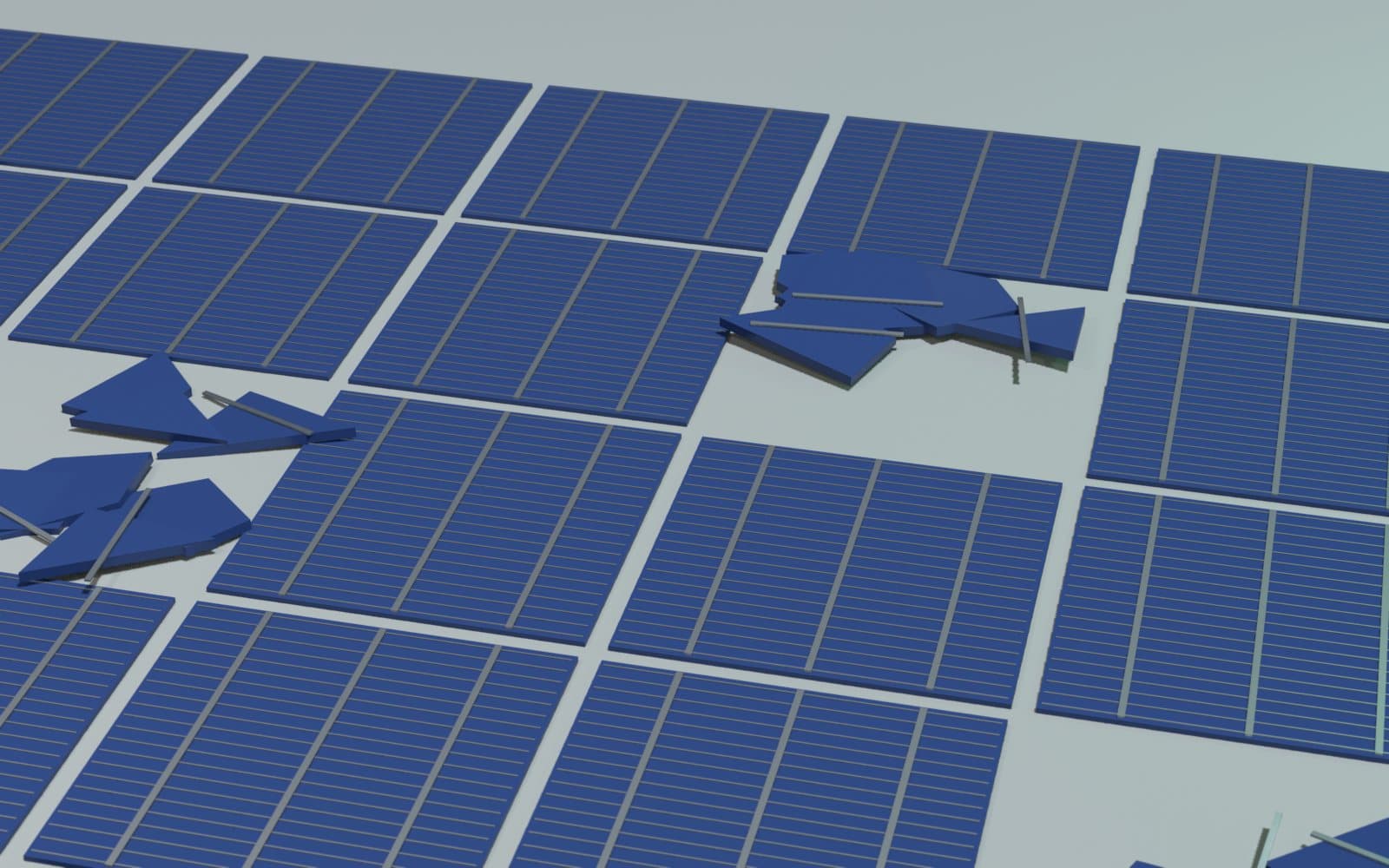
A solar panel at end of life
Glass, aluminium, silicon, silver and copper, all recoverable.
02 · Taken apart
Frame, glass, encapsulant and cells
Each layer is separated so every material comes out clean.
03 · By weight
About 75% glass, 10% aluminium
Silver is under 1% by weight but about half the value.
04 · Out
Cells gathered for silicon and silver
Glass and aluminium go straight back to manufacturers.
Step by step
From what arrives
to what leaves
- 01
Intake & inspection
Panels are counted, weighed and checked. Broken glass is handled and stored safely.
- Equipment
- Weighbridge, safe storage racks
- Principle
- Damaged modules are recycled the same way; only handling differs.
- Output
- Inspected module lots
- 02
Junction box & cables
The junction box and its DC cables are cut away first.
- Equipment
- Cutting station
- Principle
- Recovers copper and keeps diodes and plastics out of the glass stream.
- Output
- Copper cable, diodes, plastics
- 03
Frame removal
The aluminium frame is pulled off the laminate.
- Equipment
- De-framing machine
- Principle
- Extruded 6000-series aluminium goes straight to remelting.
- Output
- Aluminium frames
- 04
Glass separation
The front glass is separated from the laminated layers by heated blade or mechanical processing.
- Equipment
- Hot-knife / mechanical delaminator
- Principle
- Removing the glass first keeps it clean enough to recycle.
- Output
- Glass cullet + cell laminate
- 05
Encapsulant removal
The EVA encapsulant and backsheet holding the cells are removed thermally or chemically.
- Equipment
- Thermal or chemical delamination
- Principle
- Breaking down the polymer frees the cells and ribbons.
- Output
- Cells + copper ribbons
- 06
Metal recovery
Silver contacts, copper ribbons and their tin-lead solder coating are recovered from the cell fraction.
- Equipment
- Specialist recovery (in-house or certified partner)
- Principle
- Silver is a thin printed grid, so recovery has to be targeted.
- Output
- Silver, copper, tin, lead
- 07
Silicon reclaim
Once the metals and anti-reflective coating are etched away, the silicon itself is reclaimed.
- Equipment
- Etching & purification (certified partner)
- Principle
- Research methods have reached 99.7%+ silicon purity.
- Output
- Reclaimed silicon
Why it matters
Solar waste is
coming fast
- 01
Rapid adoption
India adds gigawatts of solar every year, and every panel retires eventually.
- 02
25-year lifespan
The first big installations are now reaching end of life.
- 03
Hazardous parts
Lead solder, and cadmium in some thin-film panels, need trained handling.
- 04
It's the law
Since the E-Waste Rules 2022, solar modules must go to authorised recyclers.
- 05
Value inside
Silver, silicon, copper and aluminium are lost if panels are dumped.
- 06
Millions of tonnes
CEEW projects 11.2 Mt of module waste in India by 2047.
Panels we take
Every type, every condition
Monocrystalline
Dark, single-crystal cells
Polycrystalline
Blue, multi-crystal cells
PERC / TOPCon / HJT
Newer high-efficiency cells
Thin film
CdTe and CIGS panels
Broken & damaged
Hail, storm, transit damage
Factory rejects
Off-spec modules & cells
Who we serve
Rooftop to utility-scale
- Solar developers
- EPC contractors
- O&M teams
- Repowering projects
- Module makers
- Utilities
- Commercial rooftops
- Insurers
Inside a panel
What a solar panel
gives back
Recovered in our process or through certified refining partners.
- 14SiSiliconCells & wafers
- 47AgSilverContact fingers
- 13AlAluminiumFrame, rear contact
- 29CuCopperRibbons, cables
- 50SnTinRibbon coating
- 82PbLeadSolder, handled safely
- 49InIndiumHJT & CIGS cells
- 52TeTelluriumCdTe thin film
- 31GaGalliumCIGS thin film
- 34SeSeleniumCIGS thin film
- 48CdCadmiumCdTe, handled safely
- GlassGlass~75% of weight
Interactive
Take a solar
panel apart
Every layer of a crystalline-silicon module, from the frame to the junction box, and what each one becomes. Then go inside the cell itself.
Scroll to pull the layers apart, then tap one.
~3% of weight
Silicon cells
Doped crystalline-silicon wafers with an anti-reflective coating
- Recovered as
- Silicon (Si)
- How
- Metals and coating are etched off and the silicon reclaimed.
Inside the cell
p-type, n-type and thin film
Cross-section, front to back, not to scale.
The workhorse of the last decade. The silicon base is doped with boron (p-type), and a thin phosphorus-diffused layer on top forms the junction. Most panels coming off roofs today are this or the older Al-BSF type.
Elements present
- Si
- Ag
- Al
- B (trace)
- P (trace)
Dopants such as boron and phosphorus are present in parts per million. They stay in the silicon and aren't recovered separately.
Safety first
No burning. No acid baths. No shortcuts.
Informal recycling burns cables and dissolves boards in open acid, harming workers and neighbourhoods and wasting most of the metal. Every stage here is mechanical, controlled or done by certified refiners, and every load is weighed and documented.
Contact Us
Have e-waste to get rid of?
Tell us what you have and where it is. We will send you a quote, collect it, and give you the paperwork.
Contact Information
Tell us what you have and where it is. We will get back to you with a quote.
- Corporate officeNo 12, F Cross, Coles Road, Frazer Town, Pulikeshinagar, Bangalore, Karnataka 560005Landmark: Above Bandhan Bank
- Recycling plant67/P4, Bidadi Industrial Area, Sector 2, 2nd Phase, Shynumangala, Bidadi, Ramanagara District, Karnataka 562109